Lighting India’s Remotest Corners
Making clean and affordable lighting solutions available in rural India.
Challenge
200 million Indians lack access to electricity
Strategy
Bringing solar lighting, a clean and affordable solution to rural India
Impact
165,000+ people benefited 720 villages received solar electrification.
Overview
World Bank figures show that approximately 200 million people in India lack access to electricity. These people rely on kerosene and other fuels to light up their homes. However, using these fuels is hazardous to health and environment. Moreover, inadequate lighting makes it hard for children to study and makes medical aid inaccessible at night
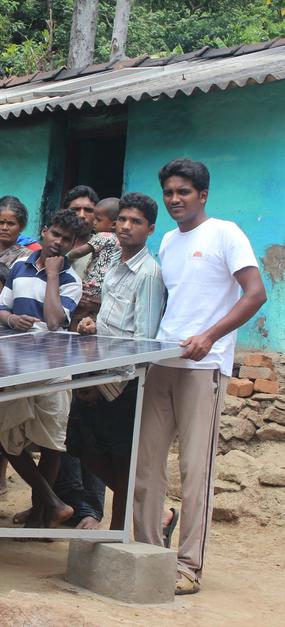
In an effort to provide a clean and affordable lighting solution to rural India, our “Light a Home” project was born. Started in 2012, the project provides high-quality and cost-effective solar lanterns, home-lighting systems and solar cookers across India. With this initiative, we have reached hard-to-access villages like Anjaw in Arunachal Pradesh, which can only be reached by foot, and river islands in Assam. Today, we have brought solar energybased lighting solutions to the more than 90,000 people in remote locations and have provided employment opportunities to many among them.
Rural Development
Develop Rural India
Bring solar lighting, sanitation facilities, strong local governance and much more
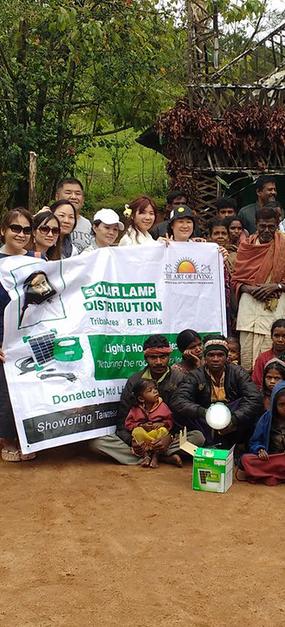
Almost 821 households do not possess any electricity in BR ranges and we have decided to light them. I am grateful to the Art of Living organization for the solar…
Ivy Ku
Art of Living faculty, Taiwan
Strategy
We have a well-defined strategy for our education projects that has been developed and refined with time. This strategy is built on three pillars:
Our strategy includes: Through ‘Light a Home’, we distribute solar lanterns and individual ‘home lighting systems’ in non-electrified villages of India. We setup ‘Solar Centre Hubs’ across rural India to provide last mile connectivity of high-quality and cost effective solar lanterns, solar home lighting systems, solar cookers & battery charging stations.
Providing free education: The majority of the students at our schools are first-generation learners who come from backgrounds of extreme poverty. The Art of Living provides free and value-based education to children from vulnerable sections while addressing the social, economic, and cultural barriers that keep children away from school.
Setting up solar microgrids: We build, own, and operate microgrids in rural belts of India, creating off-grid model villages, with access to quality lighting solutions. Our strategy is to design and develop a service-specific microgrid dedicated to providing household lighting and mobile phone charging. The design requires 90% less solar power generation capacity per customer compared to traditional solar powered microgrids.
Creating renewable energy hubs, rural engineers and entrepreneurs: We train unemployed youth in operations, maintenance, assembling, repairing, and installation of renewable energy products like solar systems, solar irrigation pumps and biogas units. Many rural youth who receive training in solar systems in our skill development centers become solar entrepreneurs in their areas.
Our three-step approach
Last-mile energy access initiative
providing solar lighting in hard-to-access areas
Setting up solar microgrids
with improved efficiency
Creating solar engineers
and entrepreneurs
Light A Home
Through this project, The Art of Living has brought solar lighting to 90,000 individuals in remote locations in India.
Impact
165,000+
people benefited
720
villages solar electrified
152
schools electrified
4100
youth leaders
trained as renewable energy technicians
310
women
entrepreneurs trained in solar systems
With your support we can achieve a lot more
A multi-faceted approach to social initiatives has saved many lives, lit many smiles, and helped communities experience progress. Every piece of service work is created with dedicated analysis, thoughtful care - keeping humaneness in the forefront.